_edited.png)
How to Find Reliable HVAC Maintenance Services
- Jun 26
- 4 min read
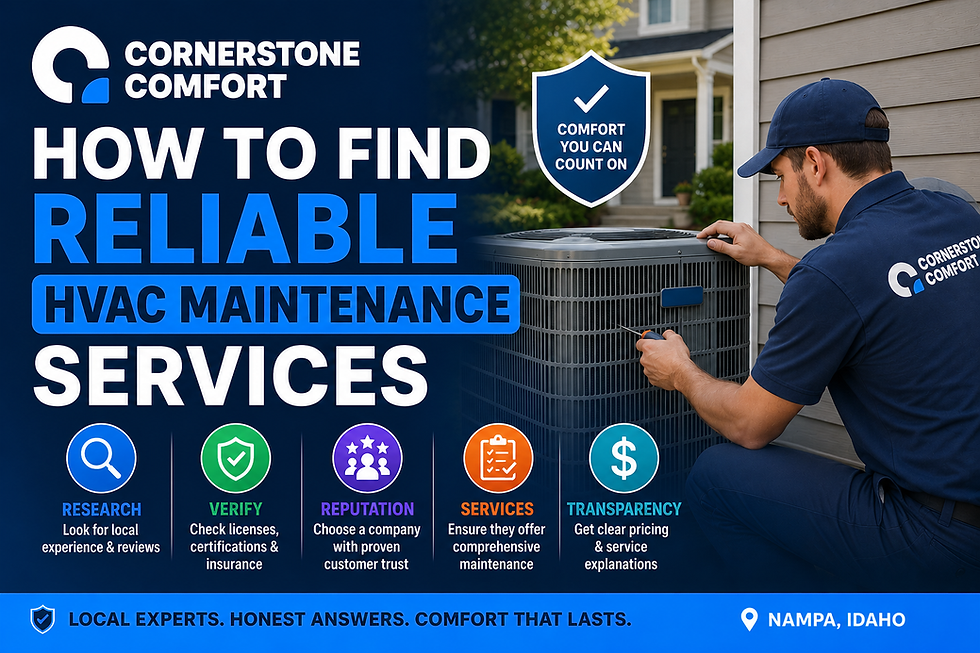
When your AC dies in July or your furnace quits in January, you aren’t looking for a flashy corporate sales pitch. You just want your home comfortable again, and you want to know that the person fixing it is competent, honest, and charging a fair price.
The problem is, searching for "HVAC repair near me" leaves you staring at dozens of companies all making the exact same promises: “Trustworthy!” “24/7 Service!” “Best Prices!”
How do you cut through the marketing fluff and find a technician who will actually fix the problem without inventing five new ones? This guide is written from a homeowner’s perspective to help you spot the real professionals and skip the scammers.
1. Look for the "Boring" Credentials First
A flashy wrapped van doesn't mean the person driving it knows how to fix a complex multi-stage heat pump. Before you even look at pricing, verify the absolute basics:
Licensing and Insurance: A reliable contractor will explicitly display or gladly provide their state/local contractor's license and proof of liability insurance. If they hesitate to share this, hang up.
NATE Certification: Look for companies whose technicians are certified by NATE (North American Technician Excellence). This is the gold standard for independent technical testing in the heating and cooling industry. It tells you the technician is a career professional, not just someone who watched a 20-minute training video.
2. Watch for the Red Flags of an "Upsell" Company
Some HVAC companies operate more like high-pressure sales teams than repair services. They pay their technicians on commission, meaning the more parts they sell you, the more money they make. Watch out for these sneaky practices:
The "Fear Tactic" Pitch: If a technician tells you, "Your system is a ticking time bomb, I wouldn't even turn it on tonight," without showing you physical proof, be highly skeptical.
The Unbelievably Low Tune-Up Fee: If an advertisement offers a $29 seasonal tune-up, be careful. Companies often use these ultra-cheap offers as a "foot in the door" to get a salesperson into your basement to find a $2,000 problem that might not actually exist.
The "Dirty Filter" Bait-and-Switch: A common trick is showing a homeowner a dirty component (like a filter or a valve) and claiming it requires a massive, immediate system overhaul.
No Written Estimates: Honest technicians give you a clear, itemized breakdown of parts and labor before they turn a wrench. If they give you a vague verbal estimate or start working before you agree on a price, that's a major red flag.
3. What a Real Maintenance Visit Actually Looks Like
If you want to evaluate if your current provider is doing a good job, or know what to expect from a new one, a legitimate seasonal tune-up should take at least 45 to 90 minutes and look like a thorough medical checkup for your system.
Here is what a professional technician should be doing:
1.Electrical and Safety Checks: First 15-20 mins.
They should tighten all electrical connections and measure the voltage and current on your system's motors. Faulty connections drastically reduce component lifespans and can be fire hazards.
2.Mechanical Inspection & Lubrication:Next 15 mins.
The technician will check all moving parts. Components that lack proper lubrication create friction, which forces the motor to draw more electricity and drive up your utility bills.
3.System Specific Deep Cleans:Next 20-30 mins.
For AC units, they must clean the evaporator and condenser coils; dirty coils sabotage the system's cooling efficiency. For heating units, they must inspect the gas or oil connections, burner combustion, and check for cracks in the heat exchanger (a critical step to prevent carbon monoxide leaks).
4.Airflow and Refrigerant Level Checks:Final 15 mins.
They will test the system's airflow and check the refrigerant level. If they tell you your system is "low on freon/refrigerant," a reliable tech will immediately explain that refrigerant does not get used up like gas—it only drops if there is a physical leak that needs fixing.
4. Read Reviews Like a Detective
Don't just look at the overall star rating; aggregate scores can be manipulated. Instead, read the reviews with a specific eye for detail:
Filter for the 1-star and 2-star reviews: Look for patterns. If multiple people say, "They came out for a simple cleaning and told me I needed a whole new system," avoid them.
Look for technician names: When reviewers repeatedly mention specific technicians by name ("Dave explained exactly what went wrong and showed me the broken part"), it's a strong sign the company employs reliable people who communicate transparently.
Check how they handle complaints: A company that replies calmly to a bad review and tries to make it right is often more trustworthy than one that ignores complaints or gets defensive.
The Bottom Line
Finding a reliable technician comes down to finding someone who values education over execution. A great HVAC pro won’t just tell you something is broken; they will invite you over to the unit, show you the rusted part, explain what it does, and give you choices. If you feel rushed, cornered, or confused, trust your gut, pay the diagnostic fee, and get a second opinion.


Comments